The data you already have but do not use
Picture a routine ticket. A user reports that their laptop will not connect to the VPN.
The analyst opens the ticket and sees a name and a description. To do anything useful, they open Entra ID to check the account and group membership, then Intune to find the device, its compliance state and its last check-in, then possibly the Azure portal. Four tabs, three logins, five minutes — before any troubleshooting starts.
Multiply that by every ticket, every day. The information exists. It is accurate. It is simply in the wrong place.
The same gap appears in reverse. A member of staff leaves, and Entra ID disables their account on time. Their laptop, however, stays assigned to them in the service desk for months, because nothing connects the two.
What Echo-9 Integration Packs are
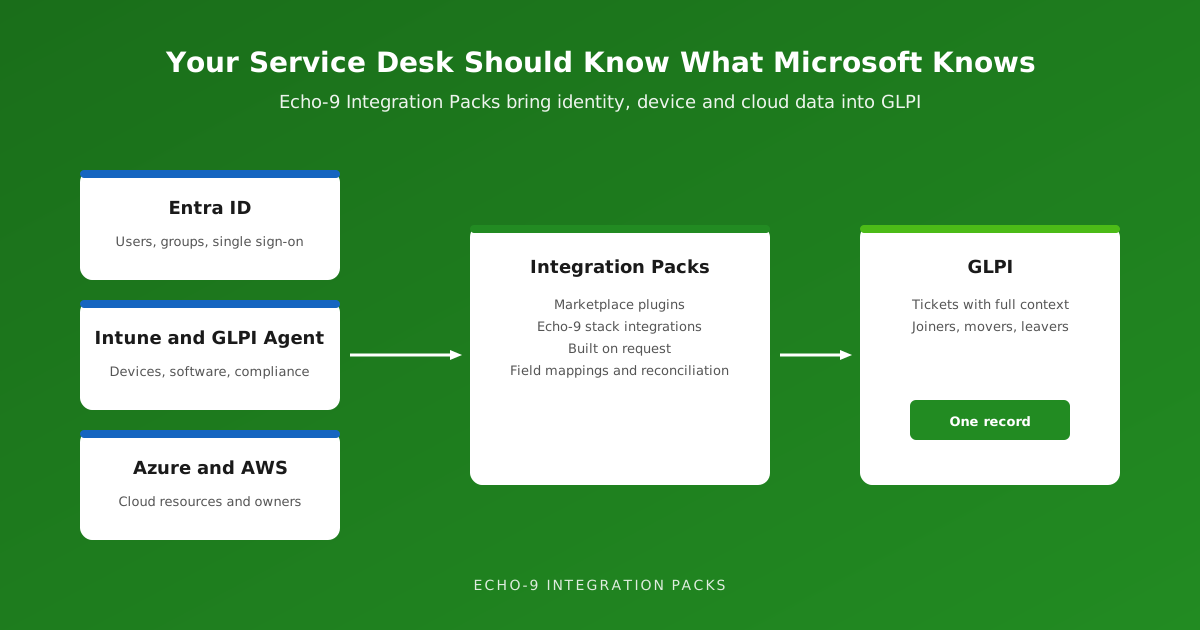
Echo-9's Integration Packs connect GLPI to the systems that already know about your users, devices and infrastructure, and normalise that data into GLPI's asset and service views.
We build every integration from three sources, and we are open about which is which:
That matters because open source only stays sustainable when you use what the community maintains and build only what is genuinely missing.
Identity: Entra ID and Active Directory
For identity, the published building blocks are mature:
- SCIM provisioning — the official GLPI SCIM plugin lets Entra ID create, update and deactivate GLPI users and groups automatically, so leavers are removed from GLPI when they are removed from Entra.
- OAuth single sign-on — users sign in to GLPI with their Microsoft account, with no second password and no separate MFA setup.
- LDAP and Active Directory — native GLPI directory integration for on-premises and hybrid environments.
Echo-9 configures these as part of a GLPI implementation. The result: every ticket is linked to a real user record with current department, manager and group membership — the context analysts were opening Entra to find.
Devices: Intune and endpoint inventory
For devices, the most reliable source of hardware and software detail is the GLPI Agent itself. Organisations using Intune can deploy the agent as a Win32 app to Windows devices, and through their MDM to macOS devices, so every managed endpoint reports its full inventory to GLPI on a schedule.
Where you also want Intune's own data in GLPI — compliance state, enrolment status, primary user, last check-in — Echo-9 builds that connector on request, mapping Intune fields onto GLPI asset records and reconciling them with agent data.
For Apple estates managed through Jamf, a published community plugin already exists.
Cloud: Azure and AWS inventories
Cloud resources rarely appear in a service desk at all. Virtual machines, databases and storage accounts are created and destroyed through consoles and pipelines that never touch the CMDB.
Echo-9 builds Azure and AWS inventory connectors on request, bringing cloud resources into GLPI so they can be linked to business services, owners and costs. This pairs with our Cloud Asset Governance consulting, which sets the tagging standards and guardrails that make cloud inventory meaningful rather than just long.
A ticket before and after integration
Before: the ticket shows a name and "VPN not working". The analyst opens Entra, Intune and the monitoring tool to understand who the user is, which device they have, and whether anything else is wrong.
After: the ticket shows the user's department and manager from Entra, their assigned laptop with its operating system, installed software and last inventory date, any open Wazuh security findings on that device, and any Zabbix alerts on the VPN gateway. The analyst starts troubleshooting immediately.
That is the practical meaning of "fewer swivel-chair operations": context arrives with the ticket.
Joiners, movers and leavers
The biggest gains often come from lifecycle events rather than individual tickets.
- Joiners — a new user provisioned in Entra appears in GLPI automatically, ready for their onboarding request and equipment assignment.
- Movers — department and manager changes flow through, so approvals and reporting follow the person.
- Leavers — deactivation in Entra can trigger a GLPI task to recover the device and reassign or retire it, closing the gap between identity and asset records.
This is where integration directly improves CMDB accuracy — the subject of our article on rebuilding a CMDB people trust.
Reconciliation: when sources disagree
Connect enough systems and they will disagree. Intune says a laptop belongs to one user, the agent reports a different logged-in user, and the asset record shows a third.
Every Integration Pack includes the unglamorous parts that make integrations trustworthy: field mappings that define which source wins for each attribute, sync policies that set frequency and direction, and reconciliation dashboards that surface conflicts for a human to resolve. Integration without reconciliation just moves the mess somewhere faster.
The bottom line
Your service desk should know what Microsoft already knows.
Marketplace plugins handle identity well. The GLPI Agent handles device inventory well. Echo-9's stack integrations connect monitoring and security. Where something is genuinely missing, we build it. The aim is the same throughout: analysts working from one record with full context, and asset data that stays accurate because the systems that know the truth keep it updated.
Discuss your integrations
Tell us which systems hold your users, devices and cloud resources, and we will map out what the marketplace already covers and what we would build.