The inbox problem outside IT
Most organisations spent years maturing IT service management. Requests are logged, categorised, routed and measured. Users can see progress. Managers can see workload. Leadership can see trends.
Walk down the corridor and it is a different world.
HR runs on a shared mailbox and a spreadsheet of starters and leavers. Facilities has a phone extension and a notebook. Finance handles purchase requests over email, with approvals buried in reply chains. Nobody knows how long anything takes, requests get lost when someone is on leave, and the only measure of demand is how busy people feel.
For employees, the experience is inconsistent at best. They learn which inbox to email, which person to chase, and which department "just works" if you ask the right way.
What enterprise service management means
Enterprise service management (ESM) applies the practices IT already uses — a catalogue, structured requests, routing, SLAs, knowledge and reporting — to other departments that provide services to the organisation.
It is not about turning HR into IT or forcing ITIL terminology on Facilities. It is about giving every service team the same basic advantages: requests that arrive complete, reach the right person, are tracked to completion and can be measured.
Echo-9's ESM consulting extends service practices to HR, Facilities and Finance, unifying the catalogue, request flows and reporting across departments. The outcomes are a cross-department catalogue, shared SLAs and OLAs, intake and triage design, and an ESM governance pack.
Onboarding: the workflow that proves the case
If you want one example to win the argument for ESM, choose onboarding.
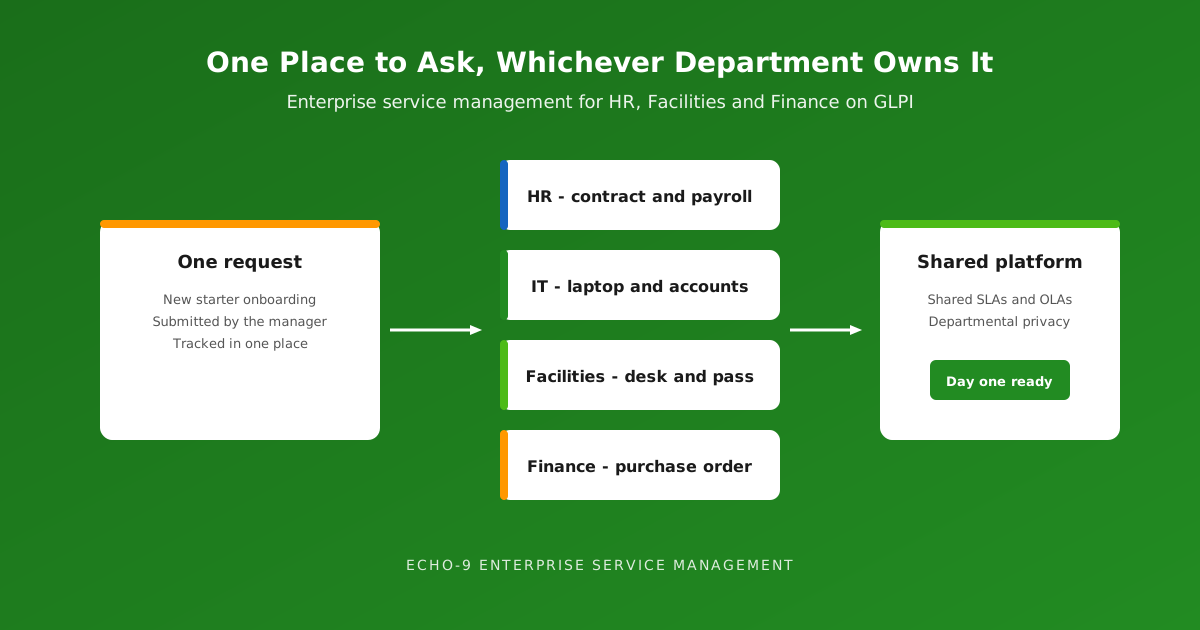
A new starter needs a contract and payroll record from HR, a laptop and accounts from IT, a desk and building pass from Facilities, and possibly a purchase order from Finance. In most organisations, that is four emails to four teams, each chasing the others, with the new employee's first day as the deadline.
In a shared GLPI platform, a manager submits one onboarding form. That single request creates tasks for each department, assigned to the right team, with dependencies and target dates. Everyone sees the same request. The manager sees progress in one place. Leavers work the same way in reverse — including recovering the laptop, which also keeps the CMDB accurate.
When onboarding works, people ask what else the platform can do.
Why GLPI suits ESM
GLPI was built for IT, but the capabilities ESM needs are already there:
- Entities and profiles separate departments cleanly. HR case notes stay visible only to HR, while the requester still uses the same portal.
- Forms and categories let each department publish requests in its own language, with the right fields for its own work.
- Approvals handle manager sign-off and budget holders without email chains.
- SLAs and OLAs set expectations per service and measure performance against them.
- Task templates break multi-department requests into assigned, trackable pieces of work.
- Knowledge base lets each team publish answers to common questions, such as holiday policy, expense rules or how to book a meeting room.
Facilities teams gain another advantage: GLPI's asset management works for building equipment, pool vehicles and AV kit as well as laptops.
One front door
Extending a catalogue to more departments creates a new problem: more forms to choose from. The answer is a better front door, not fewer services.
GilpAI matches what the user asks for to the right form, whichever department owns it. An employee types "my new starter needs a laptop and a desk" and GilpAI finds the onboarding request. LiveTalk gives them a person when they need one. For HR requests involving sensitive personal information, Sovereign AI keeps those conversations on your own infrastructure.
Governance: who owns what
ESM fails when it is treated as IT imposing its tool on everyone else. It succeeds when each department owns its services and a light governance layer holds the whole together.
In practice, that means:
- Each department owns its catalogue entries, forms, SLAs and knowledge.
- Shared standards cover naming, request types, priority definitions and reporting.
- OLAs define the handoffs between departments on shared workflows such as onboarding.
- A regular service review looks across departments, not just within them.
That is what an ESM governance pack sets out — who decides, who maintains, and how departments work together without losing their autonomy.
Why open source makes ESM affordable
Proprietary ESM usually means buying separate modules, or licences for every person in every department who handles requests. The cost of extending to HR, Facilities and Finance can exceed the original IT deployment.
With GLPI, extending to another department is a configuration and adoption exercise, not a licence negotiation. Echo-9's subscriptions are transparent and do not charge per module, so ESM becomes a question of value, not procurement.
This fits the organisations Echo-9 grew up serving: shared services, local government, education and the NHS, where one team often provides services to many others and every pound matters.
The bottom line
Employees should not need to know which department owns their request.
IT has already proved that structured service management works. ESM extends the same benefits — complete requests, clear ownership, visible progress and real measurement — to every team that serves the organisation, on the platform you already have.
Start with one workflow
Most organisations begin with onboarding, prove the value, and extend from there. We would welcome a conversation about where ESM could make the biggest difference for you.